Many woodlands across the UK are lacking in trees of sufficient age to have features suitable for roosting bats. Barnes Common in South West London is no different – while it has a number of beautiful ancient trees, many are coming to the end of their lives, and when they are inevitably lost, the trees coming through behind them are much younger.
This exciting project aims to carve chainsaw cavities and crevices, suitable for a range of tree roosting bats, directly into applicable trees, across the woodlands of Barnes Common. The features created will then be monitored using trail cameras that are capable of capturing bat activity.
This work is building upon the pioneering research by Jim Mullholland – see here for a video of Jim showing the process for creating a Bechstein’s bat feature. His work has shown that the feature creation is not detrimental to the trees (suitable trees are chosen by the arborists), and the tree seals the extracted wood panel back in place, with the cavity hidden within.
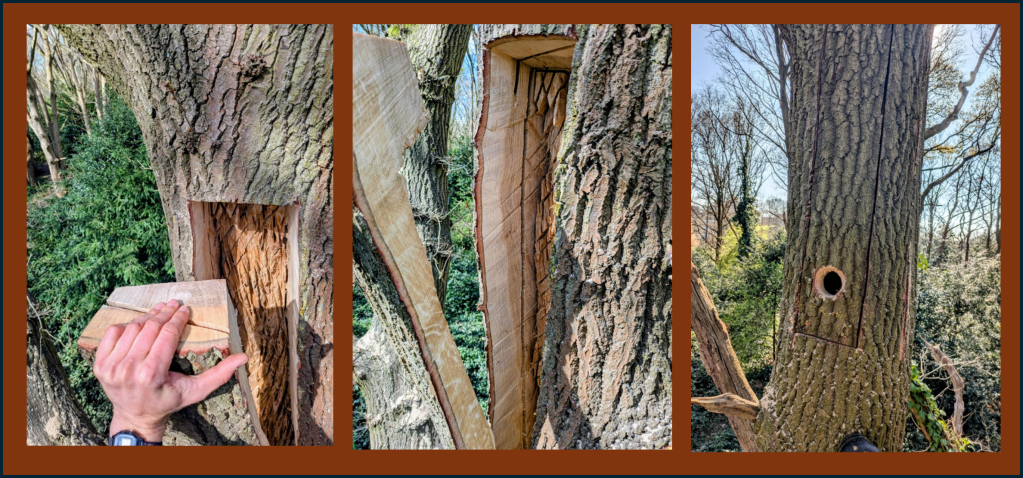
Habitat creation by Barnes Common Ltd in Barnes Common, SW13. Photo credits: Will Dartnell, BCL
The work in Barnes is being carried out by the team at Barnes Common Ltd, and one of the first things they found was that the entrances required adaptation to avoid use by Parakeets instead of the intended Noctule bats! A sloping entrance hole has been used instead, making it unsuitable for holding nesting material but still fine for bats to enter. No bats have been observed using the holes yet, but they have been seen investigating them! And there have been a number of bird species using the habitat including Blue tit, Great tit, both Greater Spotted and Green Woodpecker, Nuthatch and even Tawny Owl!
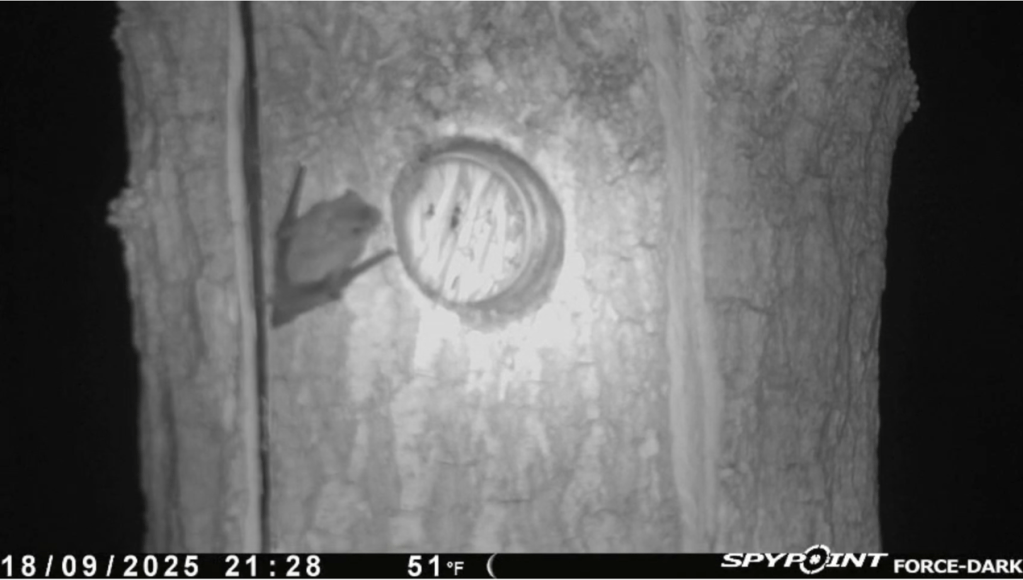
Bat investigating carved habitat in September 2025 in Barnes Common, SW13. Photo credits: Stills from video analysed by Will Dartnell, Barnes Common Ltd
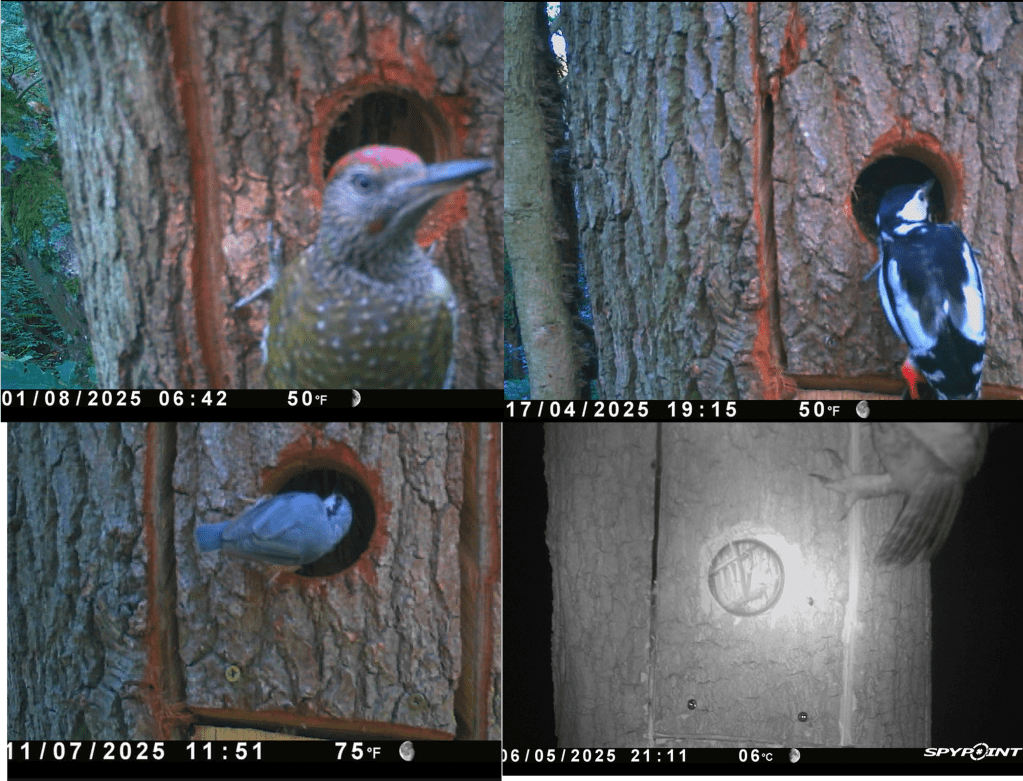
Bird species investigating the bat habitat created by Barnes Common Ltd in Barnes Common, South West London. Photo credits: Stills from video analysed by Will Scott-Mends, Barnes Common Ltd; Clockwise from top-left: Green Woodpecker, Greater Spotted Woodpecker, Tawny Owl, Nuthatch
London Bat Group has funded the cost of the works in 2025, as well as cameras to monitor the use of the features created. LBG members will be able to attend walks to see the future crevices being created, and we will be asking members for help to analyse the video footage!
For information on other projects funded by LBG, as well as how to get in touch if you have ideas for new projects that the bat group could get involved in, please click here.
 London Bat Group